

Tech
What are Port Numbers?
There are around 65535 port numbers in the network. However, there are only a few of them which are practically used.


There are many ways to transfer data and send messages on the internet. While transferring data or forwarding the message, different processes take place; the process in which the messages are forwarded to the server is identified from the port number. Many port numbers are used for networking, such as HTTP port, DNS port, and FTP port.
The port number usually consists of 16-bit numbers. It plays a role in identifying and tracking the information, which helps determine the type of information and the devices used to transfer it.
In simple words, there is a port on every networking device, and each port has a number that indicates the function it will perform and the protocol it will follow.
The port checker determines if a specific port is open and available for use on a target host. This is useful for network administrators, system administrators, and security professionals to check the status of various services running on a server, ensure that firewall configurations are correct, troubleshoot network connectivity issues, and perform security audits. By checking the status of a port, one can determine if a service is available and if it is, what type of service it is running.
Let’s move forward to discuss the details of different port numbers.
Different Types of Port Numbers and Their Uses
There are around 65535 port numbers in the network. However, there are only a few of them which are practically used. Port numbers are divided into three types: restricted, registerable, and private.
Restricted Ports: Restricted ports are those reserved by prominent companies and only accessible to employees. There are 1023 restricted ports in the range of 0 – 1023. Several services run on these restricted ports, including SQL and Apple QuickTime.
Registerable Ports: These ports can be registered by multiple companies, especially software houses, for their software. The range of these ports is from 1024 to 49151.
Dynamic Ports/Private Ports: These ports are available for anyone. This means anyone can use these ports for their use. The range of dynamic ports is from 49152 to 65535.
Here are a few port numbers with their uses and specific assigned names used in our daily and regular life.
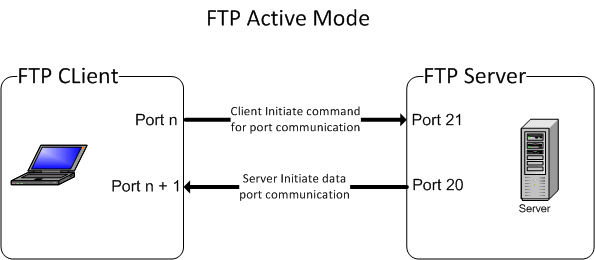
Port 20 / Port 21 – File Transfer Protocol (FTP)
The Port 20 and 21 – File Transfer protocols share files between multiple people. It uses two separate protocols to make things easy to share the files between the client and a server.
It is widely used all over the world to share back and forth the same file between a client and a server or the cloud.
Port 25 – Simple Mail Transfer Protocol (SMTP)
The port 25 – Simple Mail transfer protocol is used for sending emails. For emails sent to another person, port 25 is in use for sending the email regardless of what email platform you use.
Port 25 – SMTP helped the world to get closer and gave a reliable source to the world, which helps in sending all kinds of important messages worldwide. An SMTP tester is a tool used to verify the configuration and operation of an SMTP (Simple Mail Transfer Protocol) server.
Port 53 – Domain Name System (DNS)
The Port 53 – Domain Name System is usually used as a compiler but on the internet. The DNS port helps to make all the human-readable text in the IP address to make it a readable machine.
The port 53 – DNS port made things easy for users to find the right website. The user doesn’t have to write a long IP Address and try multiple IP Addresses to find and open the right website or application. But just writing a domain name can help in opening the right website.
Port 80 – Hypertext Transfer Protocol (HTTP)
The Port 80 – Hyper Text Transfer Protocol helps in the World-Wide Web. When you enter a domain in the browser and hit enter to open the web page. The requests from the browser are sent to the server for display, and as a result, the server sends the request to the browser for display. da
The Port 80 – HTTP has played a big role in browsers and websites. It made it easy for normal people to make their business visible on the internet through the World Wide Web.
Port 443 – Hypertext Transfer Protocol Secure (HTTPS)
The Port 443 – Hyper Text Transfer Protocol Secure works like the Port 80 – Hyper Text Transfer Protocol. Only the difference is that it is more secure and safe when it comes to data. The World Wide Web is also used to ensure the security of data transferred from browser to server or server to browser.
The Port 443 – Hyper Text Transfer Protocol Secure also connects with other ports like port 20, port 21, port 25, and more. It means you can share your personal information like credit card info, personal emails, or other private data through a secure port.
Port 3389 – Remote Desktop Protocol (RDP)
The Port 3389 – Remote Desktop Protocol helps control your desktop device remotely from another device. This helps you to access and control the desktop even if you are farther from it.
The Port 3389 – Remote Desktop Protocol also helps access a desktop of a completely random IP in your system. This allows the user to use multiple desktops of multiple IPs in the same system.
Conclusion
Port numbers play a crucial role in the functioning of computer networks and the internet. They provide a way for different applications and services to communicate with each other over the network by identifying a unique destination for each communication. Port numbers are unique 16-bit values assigned to specific services and applications, making it possible for network communication to be organized and efficient. Understanding port numbers is important for network administrators, security professionals, and individuals looking to secure their networks, as it helps in identifying potential security vulnerabilities and ensuring compliance with various security standards and regulations.

In today’s data-driven world, businesses generate massive volumes of information every second. However, raw data alone holds little value without intelligent systems that can analyze, predict, and automate decisions. This is where machine learning application development plays a transformative role.
From predictive analytics and recommendation engines to fraud detection and intelligent automation, machine learning (ML) applications are reshaping industries at an unprecedented pace. Companies that leverage these technologies gain a significant competitive advantage through improved efficiency, smarter insights, and enhanced customer experiences.
What Is Machine Learning Application Development?
Machine learning application development involves designing and building software systems that use algorithms to learn from data, identify patterns, and make predictions with minimal human intervention.
Unlike traditional software, ML-powered applications continuously improve over time as they process more data. These applications can:
- Analyze large datasets in real time
- Detect anomalies and patterns
- Predict future trends
- Automate complex decision-making processes
- Personalize user experiences
Businesses across healthcare, finance, retail, logistics, and manufacturing are increasingly investing in ML-driven solutions to optimize operations and reduce costs.
Why Businesses Are Investing in Machine Learning Applications
Organizations today face challenges such as increasing competition, rising operational costs, and evolving customer expectations. Machine learning applications provide practical solutions by enabling:
1. Predictive Analytics
Forecast sales trends, customer behavior, and operational risks.
2. Intelligent Automation
Reduce manual tasks through AI-powered workflows and chatbots.
3. Fraud Detection & Risk Management
Identify suspicious patterns and mitigate threats in real time.
4. Personalization Engines
Deliver customized product recommendations and marketing campaigns.
5. Operational Optimization
Improve supply chain management, inventory forecasting, and resource allocation.
These advantages make machine learning application development a strategic investment rather than a technological experiment.
What Do Machine Learning Application Development Services Include?
Comprehensive machine learning application development services cover the full lifecycle of AI-driven software solutions. These services typically include:
Business & Data Analysis
Understanding business goals and evaluating available data sources.
Model Design & Training
Selecting appropriate algorithms and training models using structured and unstructured datasets.
Application Development & Integration
Embedding ML models into mobile, web, or enterprise applications.
Cloud & MLOps Implementation
Deploying scalable ML systems using cloud platforms and continuous monitoring.
Maintenance & Optimization
Ongoing model refinement to ensure accuracy and performance.
A reliable machine learning application development company ensures seamless integration with existing systems while maintaining data security and compliance standards.
Choosing the Right Machine Learning Application Development Company
Selecting the right machine learning application development company is critical to achieving measurable results. ML development requires deep expertise in data science, software engineering, and industry-specific workflows.
When evaluating a development partner, consider:
- Proven experience in AI and ML technologies
- Strong portfolio of successful ML projects
- Expertise in data engineering and cloud platforms
- Scalable architecture design capabilities
- Transparent development processes
- Post-deployment support and monitoring
A trusted partner does more than build models—they align ML strategies with your business objectives.
Emerging Trends in Machine Learning Application Development
Machine learning continues to evolve rapidly. Some of the most impactful trends shaping the industry include:
Generative AI Integration
Businesses are incorporating generative AI into customer support, content generation, and automation tools.
Edge AI
Deploying ML models directly on devices for faster, real-time processing.
Explainable AI (XAI)
Enhancing transparency in AI decisions to build trust and ensure compliance.
AutoML
Automating model selection and optimization to accelerate development cycles.
Companies that adopt these innovations through advanced machine learning application development services position themselves for long-term growth.
Key Benefits of Machine Learning Application Development
Investing in professional ML development offers measurable business advantages:
- Increased operational efficiency
- Reduced costs through automation
- Improved decision accuracy
- Enhanced customer engagement
- Faster innovation cycles
- Competitive market advantage
Whether you’re a startup building a smart SaaS product or an enterprise optimizing complex workflows, machine learning solutions unlock new levels of performance.
Final Thoughts
Machine learning is no longer optional—it’s a necessity for organizations aiming to remain competitive in the digital age. Strategic investment in machine learning application development empowers businesses to transform data into actionable intelligence.
Partnering with an experienced machine learning application development company ensures scalable, secure, and high-performing AI solutions tailored to your specific needs. With comprehensive machine learning application development services, businesses can accelerate innovation, drive efficiency, and create future-ready digital ecosystems.
The future belongs to intelligent systems—and it begins with machine learning.

Are you ready to meet your perfect virtual match?
The hottest trend in AI chatbots right now is customization. Users don’t want generic AI conversations. They want AI companions they can customize to their liking. From personality traits to intimate preferences. It’s all possible with today’s virtual boyfriend and girlfriend technology.
But there’s one problem…
Customization can feel overwhelming if you don’t know where to start.
That’s why this complete guide to virtual companion customization covers everything there is to know about:
- Customization options
- Features you should know about
- Tips to get the most out of your virtual boyfriend/girlfriend
- Privacy and safety considerations
Ready to build your dream AI chatbot? Let’s dive in.
Why Virtual Companion Customization Is Important
Personalized AI experiences are more popular than ever.
Reports show the global AI companion market reached $28.19 billion in 2024. With a projected year-over-year growth rate of 30.5%. Users want the ability to customize their AI conversations. That means more control over personal preferences. Conversational styles. Intimate desires.
User personalization options and features have become non-negotiable.
With so much growth happening in the AI space, platforms that give users control over conversations are taking center stage. That’s especially true when it comes to AI sex chat experiences.
When experiencing virtual intimacy, users want a say in how the conversations go. That includes setting boundaries. Comfort levels. Conversation topics. Expectations.
If you want to create the perfect virtual boyfriend/girlfriend experience… you have to start with customization.
How Virtual Boyfriend/Girlfriend Customization Works
Not all virtual companion experiences are created equal.
The best AI boyfriend and girlfriend platforms offer robust customization options that allow you to tweak pretty much every aspect of your virtual relationship. Below are the features you should know about:
Personality And Conversation
The foundation for any virtual boyfriend/girlfriend is personality and conversation.
The right AI platform will allow you to customize:
- Tone of conversation (fun, stoic, dominant etc.)
- Likelihood to engage in certain topics
- Conversation style (short replies, longer form)
- Unique personality traits you want them to have
Keep in mind that the more you converse with your virtual boyfriend or girlfriend, the smarter they’ll get. Machine learning technology allows chatbots to continuously improve conversations over time. That’s how you develop an almost human-like experience.
Looks and Design
If you’re using a platform with visible elements, looks and design matter.
You should be able to customize:
- Physical appearance (gender, body type, hairstyle, clothing etc.)
- Background imagery
- Any profile pictures they’ll use
Details matter when it comes to virtual attractiveness. So be sure to dig into every setting you can.
Intimacy Settings
This is where virtual boyfriends/girlfriends really shine.
Not only should you be able to customize conversation topics and sexual preferences, but you should also be able to set boundaries. Rules go both ways when it comes to AI intimacy. That’s why the best AI girlfriend and boyfriend platforms will allow you to:
- Adjust pace and intensity
- Set boundaries around sexual topics
- Discover new fantasies carefully
- Customize sex talk (seductive, light-hearted etc.)
Intimacy isn’t one-size-fits-all. That’s why building a custom boyfriend/girlfriend makes you the boss.
Tips for Getting the Most Out of Your Virtual Companion
Creating your virtual boyfriend/girlfriend is only half the battle. You have to know how to bring your creations to life.
Use These Conversation Tips to Make the Most of Your AI Chatbot:
Clearly define your preferences.
Chatbots are only as good as the information you provide. That means being as specific as possible when setting preferences. If you’re vague, your bot will give you generic responses. However, if you’re detailed and clear, you’ll have a one-of-a-kind experience.
Don’t be afraid to adjust settings.
Preferences change all the time. That’s perfectly okay and part of the process.
If you find that your boyfriend or girlfriend’s personality isn’t quite how you like it, change it. Better customization technology allows you to mold everything about your AI chatbot. So make use of that and tweak settings as you see fit.
Regularly converse with your bot.
All that learning machinery mentioned earlier? It only learns if you talk to it.
Use it or lose it applies here. The more you talk to your virtual companion, the smarter and more personalized your conversations will become.
Take advantage of every feature.
Maybe you’re only into casual conversations with your bot or maybe you want a little intimacy. Regardless of your interests, don’t be afraid to explore every feature your platform has to offer.
You never know what you might discover.
Privacy and Security Concerns
There’s one piece of the puzzle that hasn’t been mentioned yet.
You know what else is important? Privacy.
This can’t be stressed enough. If you’re going to start using an AI chatbot for intimate conversations, you should know how the platform will handle your data. Here are a couple of things to look out for when selecting an AI chatbot service:
End-to-end encryption. All of your conversations should be end-to-end encrypted. That means nobody except you will have access to the conversations you have with your bot.
Know their data policies. How long do they keep your data? Will they delete it if you delete your account? These are important questions to ask. Don’t be afraid to do some outside research on a company if their data policy is too vague.
You have control over your data. Reputable companies will allow you to access your data anytime if you want. That includes your conversation history. Always make sure the company you select has this feature.
Don’t be fooled into thinking your conversations are private if the company doesn’t explicitly tell you they are.
Think your data isn’t important? 41% of users using AI chatbots for intimacy are concerned about data security. You should be too.
Virtual Companion Customization: Bottom Line
Virtual boyfriend and girlfriend technology have come a long way. Advances in machine learning and artificial intelligence have given us the ability to customize every aspect of our digital companions.
Quick Recap:
- Customization starts with personality preferences
- Appearance settings add another dimension to AI relationships
- Adjust intimacy settings to suit your liking
- Don’t forget about privacy and security
AI companions are only going to grow in popularity as the tech improves. And as more people jump on the AI bandwagon, customization features will become even better than they are today.
Don’t be afraid to test out different AI boyfriend/girlfriend platforms until you find one that meets your needs.

From long term industry observation and analytical experience within digital gambling platforms, responsible UX design has become a central tool for reducing user harm. In online casino environments, interface choices directly influence how users understand risks, make decisions, and manage their behaviour over time. This makes UX design not only a usability concern, but also a safety and well being issue.
Platforms such as Vegastars Casino operate within online casino environments where UX design choices directly shape how users perceive risk, manage sessions, and maintain control over their play. Responsible UX can reduce avoidable harm by prioritising clarity, user control, and balanced engagement. This approach is increasingly relevant for audiences engaging with Vegastars Australia, where expectations around transparency and user agency are rising.
What User Harm Means in UX
Expert evaluation of digital product behaviour shows that user harm in UX extends beyond obvious errors or misuse. In online casino contexts, harm can emerge in several interconnected forms.
Cognitive harm occurs when users are confused by complex flows, unclear information, or misleading interface hierarchy. Emotional harm appears when pressure based prompts, repeated nudges, or guilt framed messaging increase anxiety or regret.
Behavioral harm is linked to overuse patterns encouraged by design, such as endless play loops or unclear session boundaries. Autonomy and privacy harm arise when users lose control over settings, preferences, or data visibility through opaque interfaces.
Responsible UX treats these outcomes as design responsibilities rather than individual user failures.
The Problem With Harmful Patterns and Defaults
From industry observation, many digital products historically relied on patterns that maximise engagement metrics without sufficient attention to downstream effects. In casino UX, this can include default settings that encourage prolonged sessions, complex opt out paths, or interfaces that make it harder to pause or review activity.
These patterns chip away at user trust and raise the chances of regret. Over time, that erosion can strain the relationship between platform and player. For Vegastars Australia casino users, clarity and fairness in UX aren’t just design details. They form the basis for long-term engagement built on informed choice rather than subtle pressure.
Core Principles of Responsible UX in Online Casinos
Responsible UX isn’t about squeezing every possible action out of a user. It’s about drawing lines, even when that costs something in the short term. The priority shifts away from pushing behaviour and toward keeping people oriented.
That usually means choosing clarity instead of persuasion. Letting users decide, even if the path isn’t frictionless. Putting safety ahead of maximum engagement. In practice, it’s fairly simple. Plain language. Choices that can be reversed. Controls that are visible without having to hunt for them. Nothing fancy. Just design that doesn’t get in the way of understanding.
Top 5 Responsible UX Principles That Reduce User Harm
- Do no harm by design
Identify where casino interfaces could cause financial, emotional, or behavioural harm and redesign those points to minimise risk rather than relying on warnings alone. - Support user control and agency
Make limits, preferences, and exits straightforward, visible, and reversible. - Prioritise clarity and comprehension
Use simple language and clear layouts so users understand costs, rules, and consequences. - Design for emotional balance
Avoid high pressure visuals or copy that inflates urgency or stress. - Embed safety into defaults
Choose conservative default settings that reduce accidental overuse or confusion.
Concrete UX Mechanisms That Reduce Harm
Where responsible UX actually shows up is in small, practical decisions. Session information is visible, but it doesn’t interrupt play. A player logging into the Vegastars Casino platform might see how long they’ve been active, or what they’ve done recently, right there on the screen. It’s information, not a warning banner. Enough to stay aware, without pressure.
Control works the same way. A returning mobile user on Vegastars Australia can change notification settings through a clearly labelled menu and get instant confirmation. The point isn’t restriction, it’s autonomy. People move quickly online, especially on mobile, and good UX helps reduce impulsive mistakes without taking control away.
Information and Consent That Actually Work
Experience shows that long, dense blocks of text don’t help anyone make better decisions. Most users skim. Responsible UX accepts that. It breaks information into layers. Short summaries first. Details only if someone wants them.
Choices are presented evenly, without visual tricks. Nothing nudged, nothing buried. That balance is what makes consent meaningful, instead of procedural.
Informational Table: Harmful UX vs Responsible UX in Casino Design
This comparison highlights how small interface choices can significantly affect user experience and safety.
UX Area Harmful Approach Responsible UX Approach Defaults Maximum engagement settings Conservative, low risk defaults Notifications Frequent, intrusive prompts Limited, user controlled alerts Session Awareness Hidden or unclear Visible time and activity summaries Opt Out Paths Complex and buried Simple and clearly labelled Language Pressure driven copy Neutral and informative wording
Gambling Advisory Notice
Online casino gaming comes with financial implications. Outcomes aren’t predictable. Play should stay within personal limits and be treated as a paid experience, not income. The focus of this article is not promotion, but illustrating how responsible UX design principles are applied in real online casino environments.
In Closing
From expert evaluation, Vegastars Casino positions responsible UX as part of its broader product philosophy. By focusing on clarity, balanced engagement, and accessible controls, the platform reflects a design approach that recognises the inherent uncertainty of gambling while avoiding unnecessary user harm. For Vegastars Australia audiences, this reinforces trust and long term sustainability rather than short lived engagement spikes.




COUNTER-STRIKE 1.6 IN 2026
Click to rate this post! [Total: 0 Average: 0] Picture this: you boot up that old GoldSrc engine in 2026,...

International Casino Operators Expanding into Canada: Key Trends and Regulatory Insights
Click to rate this post! [Total: 0 Average: 0] Canada has rapidly become one of the most attractive markets for...


การทำความเข้าใจฟีเจอร์ของเกมสล็อตผ่าน ทดลองเล่นสล็อต ก่อนเริ่มเดิมพัน
Click to rate this post! [Total: 0 Average: 0] เกมสล็อตออนไลน์เป็นที่รู้กันว่าเป็นเกมออนไลน์ที่เล่นได้ง่ายที่สุด เพียงหมุนวงล้อ หวังให้สัญลักษณ์ตรงกัน และอาจได้เฉลิมฉลองกับชัยชนะเมื่อแสงไฟและเหรียญเริ่มกระพริบบนหน้าจอ นี่อาจเป็นภาพที่คนส่วนใหญ่มีอยู่ในใจเมื่อพูดถึงเกมสล็อต และเพื่อความยุติธรรม ก็ต้องบอกว่า มันง่ายแบบนั้นจริงๆ แต่หลังจากใช้เวลาสักพักลองเล่นเกมต่างๆ ก็จะเห็นได้ทันทีว่า ไม่ใช่ทุกเกมที่จะทำงานเหมือนกัน...


Ten Ways Lightweight Games Continue to Attract Casual Players
Click to rate this post! [Total: 0 Average: 0] Lightweight games have become a major part of the online entertainment...


Common Mistakes Players Make When Choosing an Online Casino Platform
Click to rate this post! [Total: 0 Average: 0] Choosing an online casino sounds simple at first. A player can...
Comprendiendo las Funciones de Seguridad para Decidir si play365 es confiable
Click to rate this post! [Total: 0 Average: 0] La seguridad es un tema crucial en el mundo del juego...


A Trusted Name in Online Sports Betting and Casino Entertainment
Click to rate this post! [Total: 0 Average: 0] In the fast-growing world of online entertainment, sports betting and casino...


Minecraft Hosting and Multiplayer Setup: Java, Bedrock, and Server Performance
Click to rate this post! [Total: 0 Average: 0] A strong multiplayer environment begins with a stable server. Smooth performance...


Safe Ways to Play Unblocked Games at School or Work
Click to rate this post! [Total: 0 Average: 0] Unblocked games have become a popular pastime for students and employees...


The Role of Secure Servers and Tech Behind Mega888’s Smooth Gameplay
Click to rate this post! [Total: 0 Average: 0] Most players do not consider servers, encryption, or backend support when...

Why Understanding Your Rights Is Critical in Drug-Related Situations

Scope, Stance, and Breathing: The Fundamentals That Actually Matter
COUNTER-STRIKE 1.6 IN 2026
International Casino Operators Expanding into Canada: Key Trends and Regulatory Insights

Indibet GT vs LSG Narendra Modi Stadium Win Trends & Odds
การทำความเข้าใจฟีเจอร์ของเกมสล็อตผ่าน ทดลองเล่นสล็อต ก่อนเริ่มเดิมพัน
Ten Ways Lightweight Games Continue to Attract Casual Players

Online Exchanges vs. The Nearest Bitcoin ATM: Which is Faster for Local Cash?

Elevate Your Beauty Skills With an Eyelash Extension Course
Common Mistakes Players Make When Choosing an Online Casino Platform
-

 Finance3 years ago
Profitable Intraday Trading Advice For Novices
-

 Gaming3 years ago
Pixel Speedrun Unblocked Games 66
-

 Gaming3 years ago
Subway Surfers Unblocked | Subway Surfers Unblocked 66
-

 Internet3 years ago
Welcome to banghechoigame.vn – Your One-Stop Destination for Online Gaming Fun!
-

 Gaming3 years ago
Minecraft Unblocked Games 66 | Unblocked Games Minecraft
-

 Gaming3 years ago
Google Baseball Unblocked | Google Doodle Baseball Unblocked 66
-

 Gaming3 years ago
Tunnel Rush Unblocked | Tunnel Rush Unblocked 66
-

 Internet3 years ago
Premium Games Unblocked: Unleash Your Gaming Potential