Law
Can You Claim Compensation for Injuries in Public Places

Queensland law allows you to claim compensation for injuries in public places. After all, property owners have a legal obligation to take reasonable steps to prevent foreseeable harm to visitors. When they fail to meet this standard, injured people may have grounds to make a claim under the state’s public liability framework.
These claims usually operate under the Civil Liability Act 2003, which sets out specific requirements for establishing liability and damages. Queensland personal injury firms like vbr Lawyers work within this statutory framework. This article explains how public liability law works in Queensland, what scenarios commonly lead to claims, the time limits that apply, and how legal advice fits into the claim process.
Keep reading to understand the legal requirements for injuries in public places.
What Public Liability Law Covers in Queensland
Public liability law in Queensland establishes when property owners are legally responsible for injuries on their premises.

In practice, a successful liability claim requires proving four separate elements. Courts assess duty of care, breach of that duty, causation, and quantifiable damages. Each element builds on the previous one, so proving liability depends on establishing all four in sequence.
Let’s have a look at those four legal requirements in detail:
Duty of Care Requirements
Property owners must take reasonable steps to prevent foreseeable harm to lawful visitors. However, the duty of care standard varies depending on the property type.
For example, shopping centres face stricter expectations than private rental properties. This legal obligation covers maintaining safe premises, warning visitors about known hazards, and conducting regular inspections where appropriate.
Breach of That Duty
Meeting the duty of care standard is one thing, while proving someone failed to meet it is another. Either way, a breach occurs when a property owner falls short of what a reasonable person would have done in the same circumstances.
When assessing this breach, courts usually weigh factors like cost and practicality. Besides, evidence often includes maintenance records, inspection logs, incident reports, and expert opinions about what should have been done.
Causation Between Breach and Injury
Proving breach alone won’t win a public liability claim. The injured person must show that the breach directly caused their injury.
This causation element prevents claims where the injury would have occurred regardless of the property owner’s actions. Then, courts examine the chain of events between the dangerous condition and the harm suffered.
Quantifiable Damages
Damages usually cover medical expenses, lost income, future treatment costs, and pain and suffering where statutory thresholds are met. In terms of thresholds, Queensland’s Civil Liability Act 2003 defines which injuries qualify for different types of compensation.
The compensation awarded must be calculated based on actual economic losses and legislated injury severity scales. To support this assessment, public liability claims require documented proof of financial impact and physical harm.
Common Public Place Injury Scenarios
Slip and fall accidents account for thousands of public liability claims across Queensland each year. Most fall claims share common patterns. The scenarios below represent what compensation lawyers handle most often.
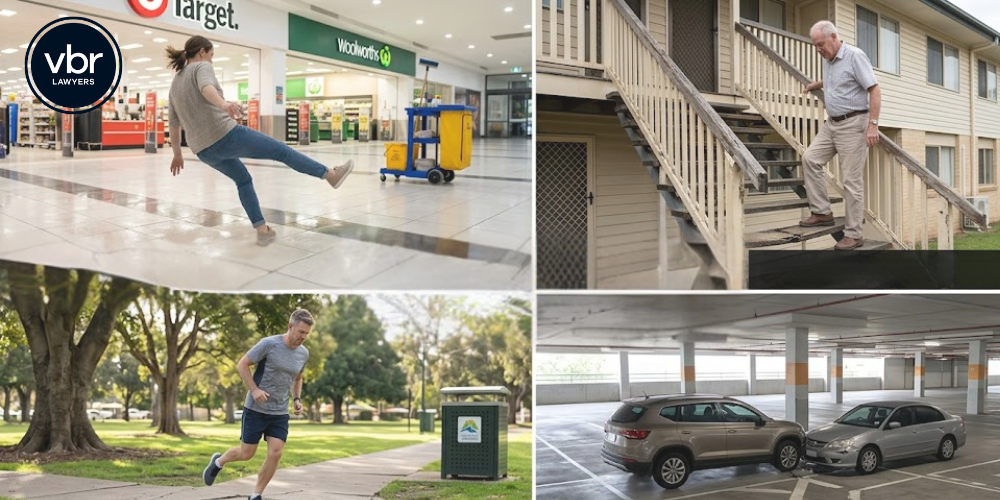
- Shopping Centre Falls: Wet floors, uneven surfaces, and poor lighting create hazards in high-traffic retail areas. These slip-and-fall claims often involve security footage and multiple witnesses (cleaning crews typically have 10-15 minutes to address spills once notified).
- Rental Property Defects: In rental properties, broken stairs, faulty handrails, and unmaintained pathways often lead to fall injuries when landlords fail to fix known issues. This poor maintenance creates liability once the property owner has notice of the dangerous condition.
- Council Facility Accidents: Public places such as parks, footpaths, and council-maintained buildings can lead to injury when hazards go unchecked. In these cases, different notice requirements may apply compared to accidents on private property.
- Private Car Park Incidents: Motor vehicle accidents can occur in shopping centre car parks when design flaws or poor maintenance affect how the space is used. Where this happens, public liability may apply if the property layout or condition contributed to the incident, potentially covering both injury and property damage.
Each scenario requires proving the property owner knew or should have known about the hazard and failed to address it.
Time Limits for Public Liability Claims in QLD
Public liability claims in QLD operate under strict time limits. That’s why understanding limitation periods upfront protects your legal position before deadlines pass. Missing a deadline here can bar your claim permanently, regardless of how strong the case might be.
Here are three separate time rules that apply depending on who owns the property where the injury occurred:
The Three-Year Limitation Period
Most public liability claims must start within three years from when the injury occurred under the Limitation of Actions Act 1974. The clock begins ticking on the accident date, not when you discover the full extent of damages.
Worth Noting: Courts strictly enforce this three-year time limit. Therefore, missing the deadline typically ends any chance to make a claim, even in cases with clear liability.
Notice Requirements for Government Property
Making a public liability claim against a local council or other local authority requires written notice before starting court proceedings. Here, time frames vary depending on the government body involved. For instance, some councils require notice within one month of the accident, while others allow longer periods.
However, the notice must include injury details, how the accident happened, location, date, and contact details to satisfy legal requirements.
Discoverability and Extended Time Limits
Some injuries don’t become apparent immediately. In such cases, the time limit may start from when the injury was reasonably discoverable in limited circumstances.
Courts also apply strict tests for these extensions, requiring evidence that the damage couldn’t have been detected earlier with reasonable care. Beyond that, minors and people under legal disability have different limitation periods, which may extend beyond the standard three-year rule for making a claim.
How Legal Advice Fits into Public Liability Claims
Legal advice in public liability claims involves assessing liability elements, gathering evidence, and navigating Queensland’s statutory framework.
At the very beginning, public liability lawyers review the duty of care owed, whether a breach occurred, and the strength of causation evidence. They assess the quantum of damages under Queensland law and examine medical reports that document the injury’s impact. This evaluation determines whether someone else’s negligence created grounds for a liability claim.
Furthermore, the claim process centres on building evidence. Lawyers gather medical treatment records, witness statements from people who saw the accident, and expert opinions on both breach and causation.
Plus, photos of the accident scene, incident reports filed by property owners, and maintenance logs all form part of the evidence base. Each piece connects the property condition to the injury that occurred.
In terms of compensation, settlement amounts and other compensation payouts vary depending on injury severity and economic losses. Besides, settlement amounts in public liability cases account for past and future medical bills, lost income, and pain and suffering damages where the injury meets statutory thresholds. As a result, you may claim compensation for future treatment costs if ongoing care is medically necessary.
Note: To support poor claimants, some Queensland compensation lawyers operate on a no-win, no-fee basis with professional fee caps. This means clients pay fees at the conclusion of the case, not upfront.
Moving Forward with Your Injury Claim
People injured in a public place face decisions about whether to pursue a claim. However, the process requires gathering evidence quickly, meeting strict deadlines, and proving all legal elements. Each public place injury case depends on the specific facts and how Queensland law applies to those circumstances.
Legal advice helps assess if the property owner’s actions created liability. Besides, compensation aims to restore financial position and address ongoing impacts on daily life, though no settlement reverses the injury itself.
If your injury occurred in Queensland, specific statutory timeframes apply to personal injury claims. vbr Lawyers is a Brisbane firm that handles these matters. Contact our Brisbane office to discuss your situation.